
AI – More Than the Next Billboard
- Posted by Chris Anderson
- Date May 23, 2026
- Categories Posts
- Comments 4 comments
How AI may reshape who gets found, who gets chosen, and where the booking happens
For close to two decades, research in this area has been interested in a simple but important question: how do travelers discover and book travel?
It turns out that the answer is not nearly as straightforward as it sounds. Travelers do not move neatly from awareness to booking. They search, compare, revisit, read reviews, look at maps, visit brand sites, return to intermediaries, and often book somewhere other than where the search process began. The path to purchase is messy, multi-touch, and not well captured by last-click attribution.
That insight sat behind my earlier work on what became known as the billboard effect. In the original Expedia-based field work, listing a hotel on Expedia increased non-Expedia reservations on the hotel’s own channels by as much as 26%. A later and broader analysis suggested that OTA presence influenced substantial additional direct demand beyond the bookings captured by the OTA itself. At the time, that finding mattered because it changed how the industry thought about intermediaries. OTAs were not simply taking bookings. They were also shaping discovery and downstream demand.
I later extended this logic to Google hotel search. There too, the issue was not simply clicks, but whether presence in the platform changed consumer behavior, channel choice, and profitability. In a switchback field experiment across independent hotels, participation in Google HotelFinder changed bookings and channel outcomes. Sponsored participation increased bookings relative to organic-only participation, and the study was designed to capture effects that would be missed by a simple platform-native attribution view.
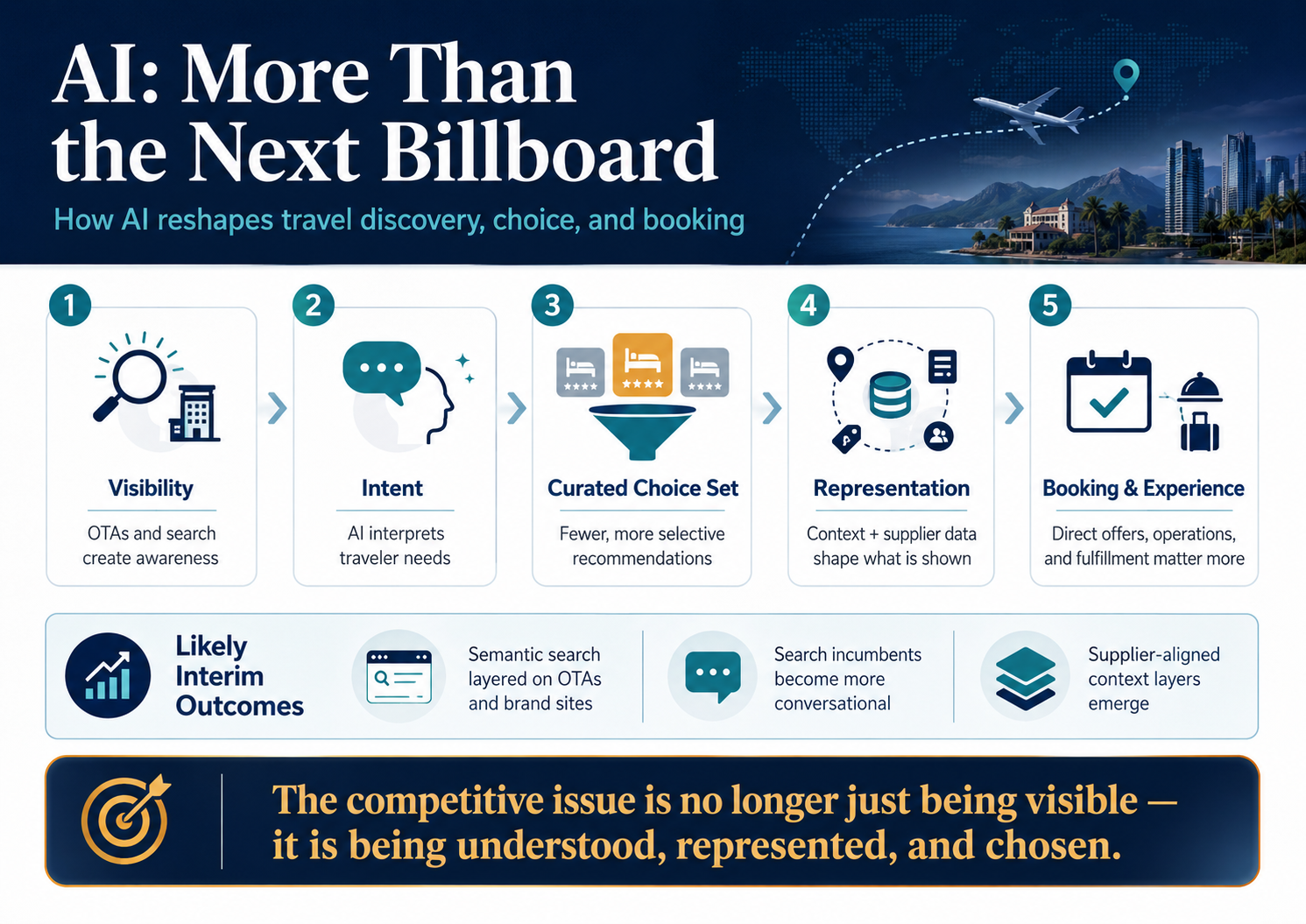
Today, travel discovery is entering another transition. This time, the shift is not just from brand sites to OTAs, or from OTAs to metasearch, but toward “AI-mediated” discovery. It is tempting to think of AI as simply the next billboard andin one sense, that is true. AI will create new opportunities for exposure. It may surface properties, brands, destinations, and intermediaries that travelers might not otherwise have considered. But that framing is too narrow. AI is more than a new shelf on which travel products appear. It is increasingly a system that can interpret the intentions of the traveler, infer the trip, shape the choice set, and influence where the booking happens.
That is why AI is more than the next billboard.
From Common Visibility to Individual Interpretation
The original billboard effect was largely about visibility in a shared marketplace. A hotel appeared on an OTA, and that presence increased awareness of that property and sometimes direct demand to that property. Google added another layer by structuring comparison across marketplaces and within the search funnel. But in both cases, the discovery was still built around a relatively static display of hotels. Broadly, everyone saw the same set of hotels, even if rankings, sponsored placement, filters, and sort order affected what drew attention.
AI changes that logic because it is not merely showing options. It has the potential to work with a much smaller shelf, to interpret traveler intent, to narrow the field, and to explain why certain options are better. That makes AI not just another display mechanism, but a more active evaluator and assessor in the discovery process.
Travel brands and digital platforms have long worked with some version of personalization. Loyalty programs, browsing history, geo-targeting, and prior purchases all theoretically provided firms the potential to tailor what a consumer saw, but the actual impact was limited. AI pushes this much further. The AI platform can learn from the current conversation, not just a retrospective, and thin, trail of clicks. It can build a richer picture of the traveler’s persona and – more importantly – the specifics of this particular trip: why they are traveling, how price-sensitive they are, what style they prefer, whether they value predictability or adventure, whether they are traveling alone, with children, or for work, and how they trade off convenience, familiarity, and experience. That moves discovery from customer-specific ranking toward customer- and trip-specific curation.
In practical terms, that means AI may do far more than reorder hotel results. AI is more capable than traditional search of identifying latent needs and translating them into recommendations. A traveler who asks for a nice hotel in Chicago may really care about being walkable to restaurants, quiet at night, easy to expense, and not overly corporate. Another traveler using similar words may care about family space, flexible cancellation, and free breakfast.
The old billboard effect helped a traveler notice a hotel. The AI effect may help a traveler identify the hotel that best fits a particular trip.
Date-and-Location to Intent-Driven Discovery
For most of the online travel era, hotel search has been dominated by structured inputs: destination, travel dates, number of guests, and a set of filters layered on top. That model gave travelers broad access to supply in a standardized format across platforms, but it also forced them to translate what they wanted into the language of the search interface. A traveler who wanted a hotel that felt special but not formal, or something easy after a late arrival with children, had to approximate those needs through crude proxies such as price bands, star ratings, neighborhoods, or amenity filters.
AI changes that structure by allowing travelers to search through expressed intent rather than only through dates, location, and predefined filters. The user can describe the trip in natural language, provide context, and refine the request through conversation. Search becomes more semantic, more contextual, and more personalized. This gives the system greater discretion in deciding which hotels count as credible matches in the first place.
In that sense, AI does not simply improve the search interface; it changes the unit of competition from presence in a large database to relevance within an interpreted request. It is not sufficient for hotels to be included in a broad inventory. They are increasingly competing to be judged meaningfully relevant to the traveler’s expressed and implicit intent.
Broad Marketplace to Curated Choice Set
A second difference is just as important. For travelers, OTAs typically offer broad access to a large, ostensibly comprehensive, marketplace. AI is more likely to offer a smaller, controlled set of recommendations.
That distinction matters. OTAs are hardly neutral and are aware that ranking matters. Win-meet-lose rankings, sponsored placement, filters, marketing spend, review volume, and brand strength all shape what gets attention and which hotels are on the first page of results. But the consumer is still exposed to a relatively broad assortment. They can scroll, sort, refine, and compare a large number of alternatives. Even hotels that are not top-ranked may still be discovered through additional search, different filters, repeat visits or supplier induced marketing efforts.
AI systems work differently. They don’t present an exhaustive marketplace and instead construct a smaller, curated set of plausible options. The traveler is not shown the shelf; the traveler is shown the assistant’s small set of selections from the shelf. And the shelf itself may be smaller because these systems must manage token budgets, latency, and user attention. [Discussions with companies integrating with major AI platforms have offered that the responses are limited to 10-20 hotels, and that very few requests are made by the AI to get the next traunch of results.]
That makes AI an even stronger gatekeeper than the OTA model ever was. In an OTA environment, inclusion on the shelf was straightforward and the strategic question was Where do I rank? In an AI environment, the more important question may be Am I included in the recommended set at all? Exclusion from that set is potentially more consequential because the traveler may never see the broader field.
This is one reason AI may produce more concentrated gains and losses than earlier digital discovery systems. The old billboard effect operated within a broad marketplace. AI may operate through controlled inclusion.
Representation Matters More Than Visibility
A further difference is that AI changes not just visibility, but representation. In the old billboard world, the central question was whether a hotel appeared on the shelf. In the AI world, the question becomes whether the hotel is represented to the system in a way that is accurate, current, and, most importantly, compelling for a specific traveler. That representation may increasingly be mediated by an AI-native context layer sitting between the conversation and supplier systems. Rather than simply exposing a static listing, such a layer can interpret what the traveler has revealed in the chat and then determine which properties, inventory, offers, room types, and booking advantages are most relevant to display. This allows the most efficient use of the limited token budget.
This also matters because hotel choice often depends on details that do not fit neatly into traditional search filters or generic OTA displays. Issues like the “vibe” of the hotel, its ability to fulfill dietary restrictions, whether it is a match for the occasion of the trip, and how it connects to its local environs. There’s another set of concerns that only suppliers can answer. Questions about adjoining rooms, member-only rates, early check-in options, flexible cancellation, loyalty benefits, and special offers. A context-aware connection to supplier inventory allows both sets of details to be surfaced selectively, based on the needs expressed in the conversation. In that sense, the competitive issue is no longer just whether a hotel can be found, but whether it is, and can be dynamically represented, as the right option for this traveler and this trip.
This is a meaningful departure from both OTA-style listing and traditional search. OTAs largely expose broad supply and then influence attention through ranking, sponsored placement, and sorting. AI can go further by combining conversational context with live supplier data to shape what is shown in the first place. The system is not simply displaying available inventory; it is deciding which inventory is most relevant to surface at that moment, to the traveler, for this trip. That makes representation more dynamic, more selective, and potentially more important than visibility alone.
Interim Outcomes?
A second possibility is that AI does not immediately displace the existing travel platforms at all, but instead becomes the new interface sitting on top of them. In this interim outcome, semantic search is layered onto existing demand systems and gradually replaces the older date-and-location-first search logic. Marriott Homes & Villas’ Search with AI offers a useful illustration of where the market may be headed: the traveler begins with intent, context, and trip needs, and only later moves into dates, inventory, and booking, guided by AI refinements along the way.
The implications of that shift could be significant. Much of online travel has long been organized around structured inputs: destination, dates, number of guests, and then a series of filters. Semantic search reverses that sequence. The traveler can begin with something closer to what they actually mean: a ski-in ski-out property for a family, a quiet hotel for a business trip, or a home rental that feels special but is easy with children. The platform then interprets that request and maps it onto its existing inventory. In that world, the incumbent’s advantage is not just supply breadth, but the ability to combine trusted inventory, reviews, loyalty data, and booking capability with a more natural and expressive search layer. The mapping to existing inventory – once encumbered by the need for structured data – is now much easier as LLMs can easily match unstructured hotel data and reviews to specific consumer needs without the need for structured data and traditional filters.
The near-term outcome, then, may not be the disappearance of OTAs and large travel platforms, but their reinvention. Semantic search may sit on top of OTAs, large brands, and other established players and make them more powerful, not less, by replacing a rigid search interface with a more conversational one while preserving the trust, scale, reviews, loyalty programs, and transaction infrastructure underneath. The competitive question would then shift again: not only who has the best inventory, but who can best translate traveler intent into a limited and persuasive set of bookable options. In this scenario, semantic search becomes both a defensive tool for incumbents and a transition stage toward a more agentic future. Travelers may increasingly start with AI-like planning tools, but many may still prefer to complete the booking with trusted travel brands rather than with the AI interface itself.
Are the winners at this stage the OTAs who have the bookable options? Or the AI companies who have the traveler intent? Or does it presage a new industry configuration which results in a better result than either?
The next step may be even more interesting when that semantic layer is linked not only to inventory, but to hotel operations. If a brand can connect conversational search to operational agents that predict room readiness, sequence housekeeping, and support room assignment, it can begin to offer consumer-valued attributes that OTAs and other intermediaries struggle to represent well: early check-in, connecting rooms, preferred floors, bed type, quieter rooms, or late check-out. Suppliers and operators occupy a singular niche within this ecosystem and AI may enable them to take much more advantage of their unique access to data that can satisfy their guests.
Importantly, this may not require full PMS or CRS integration from day one. Even partial operational connectivity through computer using agents could allow brands to surface more tailored and make strong guarantees and credible offers at the point of search. At that point, the competitive advantage shifts again, from simply matching travelers to inventory toward matching travelers to operationally feasible experiences.
A related possibility is that AI does not initially weaken the search incumbents at all, but instead strengthens them. Google’s AI Overviews and AI Mode are not separate from Search; they are layered into the existing search experience and work alongside Google’s established ranking, indexing, and information systems. In practice, that means AI results can be interspersed with the familiar blue links, maps, hotel units, ads, and other modules that already structure online discovery. The shift of the incumbent search experience towards AI tools, may make Google more useful and more durable.
This matters because search incumbency in travel has always been about more than traffic volume. It is about control over the entry point, the interface, and the monetization architecture around demand. In that scenario, AI becomes less a disruptive alternative to search than an extension of search’s existing stranglehold. Before autonomous agents take on a larger transactional role, AI may first be absorbed into incumbent search and travel platforms as a better interface for intent. The traveler asks a richer question, the platform interprets it semantically, and the answer is then blended back into the incumbent’s existing marketplace, ranking systems, and monetization logic. The result is not immediate disintermediation, but a more intelligent version of the old gatekeeper.
One emerging response is to build new infrastructure that connects hotels more directly to AI systems. DirectBooker is one example. The underlying idea is straightforward: if AI is becoming a new travel entry point, then the systems that perform best will need accurate, real-time information about prices, availability, inventory, and direct-booking benefits. Web crawling alone is unlikely to scale well for that task. Instead, AI systems may increasingly rely on structured, cached, real-time data from a relatively small number of integrations. In that world, a supplier-aligned aggregation layer using Model Context Protocol, or MCP, could give hotels a way to surface richer property data, direct-booking benefits, and more current offers than legacy OTA feeds alone.
DirectBooker is also providing the context-aware connection to supplier inventory to enable hotels information to be surfaced selectively, based on the needs expressed in the conversation. And it enables those needs to be communicated back to the supplier. This context can be used to modify the booking experience to the benefit of the traveler and the bottom line of the hotel.
Another important issue is online reputation. In earlier digital discovery, reviews and ratings often sat alongside search results as one more input for the traveler to inspect. In AI-mediated discovery, those signals are more likely to be absorbed into the recommendation itself. AI systems can use reviews, sentiment, and third-party descriptions to infer fit, summarize tradeoffs, and explain why a hotel may or may not suit a particular traveler or trip. Reputation therefore becomes more than a validation tool. It becomes part of the search, matching, and explanation process. At the same time, it becomes gameable, as fake reviews, and fake sites become more difficult to ascertain when they’re hidden inside the UX of the AI tools. Suppliers represent a critical mechanism to determine authenticity.
Whether any one firm wins is less important here than what these moves signal. The market is beginning to recognize that the AI question is no longer just How do I show up? It is also How do I provide the data, offers, and context that allow AI to represent my property well? That is a different strategic problem from classic SEO, classic metasearch, or classic OTA distribution.
For hotel owners, operators, and brands, the practical implication is that success in AI-mediated discovery may depend less on raw visibility and more on being legible to AI systems. A hotel that is easy for an AI assistant to understand and describe may have a disproportionate advantage. Clear property identity, structured amenity data, consistent location information, strong photos, distinctive guest-experience cues, and coherent reviews all help the system infer where that property fits and for whom. In an AI-mediated environment, content is no longer just marketing content. It becomes machine-readable evidence about the type of traveler the property serves best.
That also means suppliers need to be more deliberate about how their information enters the AI ecosystem. Public-facing hotel content will increasingly be read, summarized, and reused by AI systems unless suppliers actively manage it, so hotels should think carefully about what descriptive information they publish openly and what information they provide through more controlled channels. At the same time, it becomes increasingly important to ensure that the hotel’s official site, official rates, and official offers are clearly identifiable to both travelers and AI systems, and that impersonating or misleading third-party representations are addressed quickly. The more advanced opportunity is not simply to be visible, but to provide real-time offers, benefits, and booking options that reflect the context of the conversation and the needs of the traveler at that moment.
At the same time, it is incumbent upon these groups to make sure that their properties are providing data directly to the AI tools by whatever means possible to maintain parity with the OTAs. MCP-sourced data, referenced earlier, can override and modify the information that is presented on the web and early indications are that it is more trusted by the AI tools.
This creates opportunities for both major brands and independents. Large brands may benefit from stronger digital footprints and clearer trust signals. But smaller or more distinctive properties may also benefit when they are easy for AI systems to understand, describe, and match to specific traveler needs. In that sense, AI may reward not only scale, but clarity.
Closing Thought
When I first wrote about the billboard effect, the core insight was that intermediaries can create value even when they do not capture the final transaction. That insight still holds.
But AI changes the mechanism. The old billboard effect was mostly about visibility. The new one is about visibility plus interpretation, controlled inclusion, and representation. AI may know more about the traveler, infer more about the trip, and shape not only what is seen, but what is considered plausible in the first place.
That is why AI is more than the next billboard.
In the near term, AI may not eliminate existing gatekeepers so much as reshape them. Search incumbents, OTAs, and large brands may absorb semantic search and become even better at interpreting traveler intent and steering demand. Over time, more agentic systems may take on a larger role. But regardless of the path, the competitive issue is already shifting. It is no longer enough to be visible in a broad marketplace. Hotels, brands, and intermediaries will increasingly compete on whether they can be understood by AI systems, matched to a traveler’s needs, and represented credibly in a narrow set of choices.
The next battle in travel discovery may not be won simply by being listed, or even by being ranked. It may be won by being the hotel, brand, or channel that an AI system can best understand, best represent, and most confidently present as the right choice.
Chris K Anderson, Cornell University, canderson@cornell.edu
Sanjay Vakil, DirectBooker, sanj@directbooker.com

4 Comments